
Feeling overwhelmed, stuck, or swept away by your emotions?
Finding Calm in a Chaotic World: Simple Practices for Anxiety, Sadness & Getting Unstuck
3 on-demand modules for life’s toughest emotions
Videos, audio exercises, and a downloadable workbook
Lifetime access,
return whenever you need to
Feel a shift after the first session
Sound familiar?

There’s a third way. And it’s simpler than you’d expect.
Instead of fighting your feelings or drowning in them, you learn to turn toward them, with curiosity and compassion. And that makes all the difference.
Here’s what becomes possible
Whether you’re brand new to this kind of inner work or you’ve tried other approaches, this course meets you where you are so you can find steadiness no matter what life brings.
Instead of spiraling or white-knuckling through it, you can bring calm to stressful moments.
You stop fighting the critical voice and start hearing what it’s actually trying to say. And that’s often enough to be genuinely kinder to yourself (and strengthen your connections with others).
You can find a way forward. Not by forcing yourself, but by listening to the parts of you that are hesitant or resistant.
You don’t have to push it away or drown in it. You can be with what hurts in a way that brings peace without forcing yourself to move on.
That’s just some of what happens when you stop fighting your feelings and start listening to them.
Strong emotions like anxiety, feeling stuck, and sadness are messengers.
Common approaches center around doing something to our emotions. Calm them down, reframe them, breathe through them, journal about them. Sure, those can help, but what do you do when they don’t?
Trying to fix, avoid, or fight feelings often makes them stronger; their messages are too important to let go. When you can hear what they’re really trying to tell you, they can relax and shift. Students often tell us that just being with their emotions, even the stressful ones, brings a sense of relief they didn’t expect.
If you’ve tried meditation:
This isn’t about quieting your mind. It’s about being with what’s there, however loud or messy.
If you’ve tried therapy:
This works alongside it well. And it gives you something to do on your own, between sessions or after.
If you’ve tried journaling:
This moves you from thinking about your feelings to actually being with them. Different layer, different result.
If you haven’t tried anything yet:
This is a gentle, guided place to start. No prior experience needed.
What you’ll work with
Six of the most common emotional challenges, each with two guided practices:
a shorter introductory exercise and a deeper 30-minute session.
Soothe Anxiety & Fear
Comfort Grief & Sadness
Find Motivation When You Feel Stuck
What you get
Each module includes gentle, guided exercises, plus ways to bring the practice into your life when challenges arise.
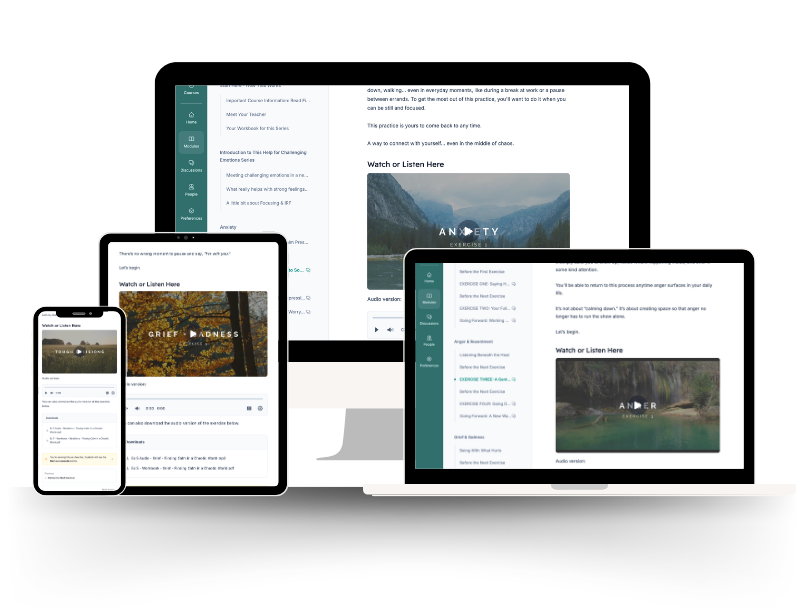
Two exercises per topic to stream online or download to listen whenever and wherever you need them.
Each practice can bring unexpected insights. Capture them before they slip away.
The hard things keep coming. Come back to any practice whenever you need it. It’s yours to keep.
A warm, supportive space to share what’s coming up and hear from others doing the same work.
Your guide: Ann Weiser Cornell
Since 1985, Ann Weiser Cornell has been teaching Focusing, a gentle process for working with difficult emotions, to therapists, coaches, and anyone who wants to feel better in their own skin. She’s one of the world’s leading authorities on the practice, and this course is grounded in her method.
Her book The Power of Focusing (New Harbinger Publications) has been translated into multiple languages. She’s also the author of Focusing in Clinical Practice (W. W. Norton & Company), past president of the Association for Humanistic Psychology, and holds a PhD in Linguistics from the University of Chicago.
I used to snap under stress, crumble at criticism, or shut down when things got hard.
What I discovered was a simple, reliable way to meet those moments with more calm, clarity, and compassion. I’ve been sharing this process with thousands of people all over the world and now you can benefit from it too, and I’ll show you exactly how.

Ann Weiser Cornell
Co-Founder, Inner Relationship Focusing · Author · Teacher
Ready to begin?
Some things people ask before enrolling
What exactly is in the course?
The course covers three emotional challenges: anxiety, grief, and finding motivation. Each module includes two guided practices plus written content to help you bring what you’ve learned into your daily life. You can stream the practices online or download them to listen whenever you need them. There’s also a downloadable workbook. Work through everything in order, or start with whatever feels most relevant right now.
Do I need any experience with meditation or emotional work?
None at all. This course is designed for people who are just beginning to explore this kind of inner work. Every practice is guided step by step, and there’s no right or wrong way to do it.
I’ve tried meditation apps and journaling. How is this different?
Apps and journaling tend to work at the level of the mind, observing thoughts, tracking moods, building habits. This approach is different. Instead of thinking about a feeling, you learn to turn toward it directly. Most people find it reaches places other approaches haven’t.
How long are the practices? Can I fit this into a busy day?
The introductory exercises are short enough to do during a break. The deeper practices ask for about 30 minutes in a quiet space. The course is self-paced, so you can move through it at whatever speed works for you.
How quickly will I notice a difference?
Many people notice something shift after the very first practice, a sense of more space, a little more steadiness. The deeper shifts tend to build over time as the approach becomes more familiar.
Is this therapy?
No. This is a self-guided learning course, not therapy or counseling. That said, many therapists use this approach in their own practice, and the course works well alongside any support you’re already receiving.
What if it’s not right for me?
If you let us know within 30 days of your purchase that we didn’t deliver what we said we would, just ask and we’ll cheerfully refund the full course fee.