I Know I’m in There Somewhere:
A Woman’s Guide to Finding Her Inner Voice & Living a Life of Authenticity
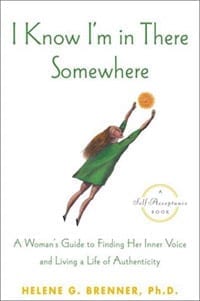
by Helene G. Brenner, PhD
with Laurence Letich
(NY Gotham Books, Division of Penguin Group, 2003)
283 pages, Paperback
Based on her work with over a thousand women across the country, psychologist Helene G. Brenner has learned that women feel the impulse to accommodate, adapt and mold themselves to serve others at their own expense. Her solution is an invigorating new approach to women’s psychology. The key to transformation, she explains, is not self-improvement, but self-acceptance — affirming and validating what we truly feel and experience and who we already are. Helene shows women how to discover and express what they truly want and value, guiding you toward your own Inner Voice.
A Review by Ann Weiser Cornell
This article originally appeared in the July 2003 issue of The Focusing Connection.
“At last! Finally! Yes!” These are my reactions as I hold this beautiful and inspiring, warm, wise, and funny book in my hands. How rare it is that something appears which is so validating of the Focusing viewpoint, yet positioned for such a wide audience! We Focusers tend too much to write and speak for and to each other – I’m as guilty of this as anyone – and forget that our messages and methods have wide application for a world of people hungry for ways to understand and heal themselves and their relationships. I Know I’m in There Somewhere delivers on every level: the deep veins of the Focusing philosophy are offered in a nurturing matrix of wisdom, speaking directly to the hearts and souls of women (and by implication men as well) who are yearning to find again the inner guidance to en-spirit their lives.
Helene Brenner is a longtime Focusing teacher and Focusing-oriented therapist, and a dear friend and colleague of mine. (I should say in the interest of full disclosure that I am mentioned a number of times in this book, and I’m proud that my “formulations and practices” have contributed to something so fine.) Helene got the idea to write this book when she realized that something consistent was happening with her therapy clients. I’ll let her tell it: “Working with my clients, I found that at some point in therapy, they would have moments when a switch would occur in their consciousness. … Women would go from seeing themselves and their lives from the outside to feeling them from the inside. They’d feel a surge of good feeling about who they were, and whatever they thought they had to change about themselves they’d see in an entirely new light.
“I saw these experiences as central to the therapy I was doing. I saw women come more alive as they trusted more and more what their own hearts, minds, and souls were telling them. And I looked for ways to help women come to their own inner voices more quickly and predictably.” This book is the result.
There is something quite radical in this book. Helene writes: “I truly believe that you don’t have to change or fix or improve yourself in order to be happy.” And: “You don’t have to be bigger or braver or smarter or more organized than you are to begin pursuing your inner visions — and you don’t have to clean out your closets first!” Why does almost anyone interested in personal growth own shelves full of self-help books, mostly unread and certainly unsatisfying? Because most of these books give a subtle or not-so-subtle message that something is wrong with you and you must fix yourself (with their exercises and methods) in order to be OK. It’s the saddest trick of modern culture: evoke an inadequacy and then sell the remedy that claims to fill it.
We know that something is wrong, somehow, and so no wonder we buy these books. Yet the experience of being “wrong” inside is a key part of the problem, and having it reinforced truly doesn’t help. On the other hand, that sense of wrongness does need to be heard, as a starting place. Helene walks this line with grace, filling me with admiration: rarely does a book for a popular audience have so much of a sense of holding the ambiguity: being able to affirm that both are true — something is wrong, and we are deeply OK.
“What really works is so simple it’s hard to believe. It’s stopping your efforts to fix. It’s getting below all the voices in your mind telling you what’s wrong with you and how to change yourself and simply allowing what is truly happening to emerge. And then accepting and being with it, exactly as it is. Time and time again, this has made all the difference in the world.”
The key message of this book is that women (and all of us really) have lost connection with something Helene calls “the inner voice,” and that reconnecting with it is the key to living a fulfilled and fulfilling life. What is the inner voice? I wondered as I began to read. Is she really talking about Focusing by another name? The answer I came to find is that the inner voice is not the same as Focusing, but it’s something Focusing can help us find.
“When it feels right, there’s a sense of an inner resonance, an inner matching. When a thought or an action doesn’t match, it feels ‘dissonant’, discordant, wrong, like something within you disagreeing. I know that people are getting back in touch with their inner self when they stop saying, ‘Why am I doing this? What’s wrong with me? Can you make this bad feeling go away?’ and begin checking with themselves and saying, for example, ‘Gee, I thought I felt this way, but I really don’t. This is how I feel.'”
The inner voice as Helene describes it is something that everyone who does Focusing will know, I’m sure. Yet perhaps we haven’t had as much validation for it, certainly not from the culture around us, as we need in order to really believe in it. “Your inner voice is the wisdom of your entire self as it makes itself known to you. It expresses itself in many ways; as impulses, as urges, as body feelings, as a sense of knowing what you need and what to do, as a deep desire, and sometimes as a wisdom that can seem to come from beyond your physical body. Your inner voice directs you toward greater fulfillment in your life the way a flower turns toward the sun.”
If you want belief in the power of the inner voice experience, all you have to do is read the many stories Helene has collected, mostly from her own clients’ experiences, about their realizations and transformations. I loved the story of Robin, a minister who had stopped enjoying her work, and in fact had stopped enjoying practically everything. She was smiling and smiling, hiding her feelings from everyone — including herself — until the day in Helene’s office when she acknowledged how painful life had become. “I just sat there with her, accompanying her in that painful corner of time where there are no answers, and the only comfort is the acknowledgement of the truth. She sat sobbing quietly, tears rolling down her cheeks.
“The next week she had tears in her eyes — but for a different reason. ‘This is the way I used to feel, but I can’t even remember when,’ she said. ‘I feel alive again. I talk to my congregation all the time about love. But this week, my stepson hugged me and said, “I love you,” and for the first time, for the first time, I felt it.'”
As Focusers we know that, as Eugene Gendlin puts it, “a few moments of feeling it in your body allows it to change.” But we aren’t used to living in a world that supports and validates that knowing. And we haven’t had enough articulate and compassionate voices speaking out for this way of being that is not a way of fixing. What a blessing it is to read about Helene’s “ABC’s: Acknowledging, Being With, and Compassion.” Isn’t that truly what it’s all about? What a thrill of hope I feel as I imagine this book going forth in the world, making an impact (Helene has already taped one national talk-show appearance, and there will be more) with wisdom like this: “Acknowledging means acknowledging whatever you discover is true inside, without judgment, even if it’s a feeling or a want that you don’t think you ‘should’ have. When you acknowledge, you are not denying your experience. You are not trying to change, fix, or wish it away, and you are not making it smaller or bigger, better or worse than it is. You are simply letting your inner experience be, exactly the way it is.”
Or this: “Compassion has many names. Gentleness. Empathy. Tenderness. Loving-kindness. Even softness. Compassion, especially self-compassion, is at the very heart of living from your inner voice. Nothing can be accomplished without it; with it, you can bring about miracles. When it is extended to any part of your self that is stuck in suffering, that part begins to heal. Extend compassion toward the hurt, angry, and fearful places, the vulnerable places, the foolish places, the clumsy and ‘defective’ places, and even the darkest, most unacceptable places inside of yourself and others, and you’ll begin to feel a peace, calm and presence within you that you can barely imagine.”
Therapists Take Note
This book works on so many levels, and I need to mention one that stood out for me: the master therapist. In Helene’s varied practice there have been clients of all kinds, including women who have survived trauma and abuse. A number of the stories in her book are about such women, and I can imagine that anyone who works with clients healing from severe past pain would be inspired and supported by Helene’s willingness to share what she actually said and did with such clients. Sometimes popular books offer methods that would work only if the person trying them were already 99% fully functioning. Helene makes it clear that some of her clients have been quite depressed and have faced severe setbacks. Treating these issues with great respect, she also offers hope, and that is priceless.
One can’t help but feel how lucky Helene’s clients are to have her — listening, encouraging, teaching a little, sometimes even intervening. Take Simone, who had “what looked like the very model of a modern egalitarian marriage.” Both she and her husband worked and cooked and did the household chores. But her husband was following his dream, and Simone wasn’t.
“‘You know, I always learned that when you got married, you worked together, you became part of a team,’ she told me.
“‘Yes, that’s true,’ I agreed. ‘But I have to wonder, is he part of your team?'”
The Five Pathways
There is much more in this book than I can cover in this review. The validation of needs is a powerful gift to anyone who has ever called themselves “needy.” The section on “outer voices” gives a different perspective on what we often call the inner critic. The two chapters on following the inner voice in relationships are so packed with helpful guidance that they could certainly be a book in themselves — and I hope they will.
What I do want to describe before stopping is something Helene calls the Five Pathways to the Inner Voice: Knowing, Sensing, Feeling, Wanting, and the Voice of the Larger Self. It is these five helpful and practical chapters, filled with stories and what Helene calls “Innercizes,” that form the heart of the book.
Knowing. When we feel confused and stuck in our lives, we often find ourselves saying, “I don’t know.” Helene offers specific techniques for unlocking our inner knowing, for finding out and affirming what we do know. Following the Innercize “What Do I Know to Be True?”, I could easily see how to start with what I know and let that knowing expand, instead of getting stopped by how much I don’t know.
Sensing. This is the chapter in which Focusing is central, in a message that Focusers will recognize and applaud, while gaining perhaps new insights into its universality. “While many still believe that it is only through transcending the body and its feelings that one reaches a more spiritual state of being, I believe the very opposite is true. Predominantly, the inner voice speaks through the body. Your path and purpose in life and the steps you need to take become much clearer when you open up the pathway that leads to your inner senses. Sensing the body, far from drawing you away from your mind or your spirit, actually leads you to an expanded sense of self.”
Feeling. This chapter is called “Having Your Feelings Without Them Having You.” This is indeed the key that so many people out there don’t know: that you can be with your emotions without becoming them. As Gendlin used to say, “To find out how the soup smells, you don’t have to stick your head in it.” Sitting with our feelings, listening to the unheard voices, and the power of validation are just a few of the gems in I Know I’m in Here Somewhere.
Wanting. I have long believed that desire is the “compass needle of the soul,” and Helene’s approach to the importance of wanting is right in line with this. In this chapter called “The Lost Art of Wanting,” she emphasizes the power of wanting. “Wanting is the psychological vehicle, the motor, the muscle, that moves you from where you are to where you are going. … Your true wants are at the very core of you, expressing your individuality, because they are as unique and individual as your fingerprint.” The Innercizes in this chapter are delightfully enticing, as are the ones in the twin chapter on Manifesting later in the book. We are invited to claim our wants, shown what to do with desires that are really too much right now (make a “ten-degree change”), and let the process of wanting be our guide.
The Voice of the Larger Self. Like much of Focusing itself, this is a profoundly spiritual book if you read between the lines. In this chapter, the spiritual perspective is made explicit. The voice of the Larger Self is the “spiritual guide within,” and the stories Helene tells of people in the midst of pain getting in touch with this voice are deeply moving. Almost by accident, as she tells it, she learned how to guide her clients to get in touch with this Larger Self and hear its voice. “I have heard countless Larger Self messages by now, and what strikes me most, besides their incredible gentleness and warmth, is how they share themes that have been repeated in the sacred texts of all religions: You are not alone. You are loved, exactly as you are. You have a path and a purpose all your own for being on Earth, and you can start unfolding toward that purpose at any moment. You are larger and more protected than you think, and needn’t defend yourself as much as you imagine. Love is the most important quality to manifest in all of your relationships.” This too comes in and through the body, so these messages are known and sensed — and therefore lead to true transformation.
The Gift of a Writer
As gifted as Helene is as a therapist, that’s how gifted her husband Larry Letich is as a writer. After Helene formed the clear intention to write this book, Larry stepped in and became her full-time writing partner. He is also a Focusing teacher, and a published author on gender issues and politics. No one who knows Larry could imagine that he kept his own ideas out of the formation of this book! The truth is, this book is the result of a partnership of these two compassionate and brilliant beings, building on their unusually close marriage of over twenty years and the interweaving of their minds, hearts and spirits. Larry and Helene are each other’s best friends, and it shows. I Know I’m in There Somewhere has been written and rewritten until it shines like a jewel, and it was Larry who did most of that, especially in the chapters on making Focusing understandable.
I can’t resist mentioning how funny this book is. I chuckled often as I was reading it. Here’s one example: “This leads to my ‘toothpaste tube’ theory of personal growth. You never know what you’re capable of until you’re being squeezed.”
I think you’ve figured out by this time that I really love and believe in this book. I’m recommending it, not just to you, but to your families, your friends, your co-workers, your neighbors… This is a “buy ten and give nine away” type of book. We’ve always known that Focusing could change the world. I Know I’m in There Somewhere may be the best tool for that purpose we’ve had in many years. Let’s use it!